Tag Archives: Journalism

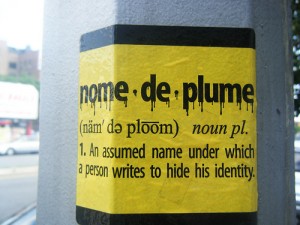
Of Pen Names and Pseudonyms

28 Sep

In the age of new media, how do we value anonymity? Does using a pen name devalue journalism? The recent publication of a review written by a critic using a pen name ignited a debate between critics and performers on the need for pseudonyms in criticism. Some said that anonymous reviews “…completely negate the credibility of your magazine”, whilst others dismissed the practice as “cowardly”.
So, are anonymous reviews ever okay? Yes. I believe that using a false name does not mean a writer is peddling false information or an untruthful review, and using an assumed name doesn’t mean that a writer doesn’t stand by their work. In fact, I have two writers that use pen names as a way to separate their reviewing lives from their everyday lives and future careers. I understand why they do this, and I’ve always been very open with venues and editors about their assumed names.

A professional writer’s reasons for choosing anonymity over a recognisable byline aren’t due to nefarious reasons or ulterior motives. Pen names have long been part of the journalism industry; in the 18th and 19th century, it was very common for journalists to produce pieces under a different name. In fact, George Bernard Shaw began his career working as a music critic for The Star, using the pseudonym, Corno di Bassetto. Similarly, as a young student, Arthur Miller wrote criticism under the name Matt Wayne and Anthony Burgess was a pseudonym based on the writer’s birth name, John Anthony Burgess Wilson.

Obviously the growth of the internet has made anonymous critics, whether they are existing critics or the public, commonplace However, those that choose not to reveal their names when writing reviews aren’t trolling. Their lack of identity doesn’t mean that they lack morals or basic journalism training; their reasons for staying anonymous are many and are often very personal.

For example, a writer might choose to write under another name because an established journalist already uses their name. I’ve never used a pen name, however, in the future, I might have to use one, because there is already a journalist called Amy Taylor, and using another name, or simply using my initials might end any confusion between the two of us.

Another reason would be that the writer has a name that is hard to pronounce or spell, so simplifying it would make them easier to search for online, and also make their name much easier for editors and readers alike to remember. Or a writer may want to give themselves a new name in order to improve or make their birth name more suitable to their vocation. After all, would you rather read an essay by an author called Thomas Lanier Williams III or Tennessee Williams?

Some writers choose a pen name to end the limitations of their name, or begin to write pieces in a different style, or about a different subject. In 1977, Steven King, fearing he would oversaturate the horror novel market by publishing too many books in one year, began writing  under the pseudonym Richard Bachman. His alter ego was ‘killed off’ very suddenly in 1985, when an intrepid book store clerk uncovered Bachman’s real identity.

Similarly, Iain Banks, who wrote the horror novels The Wasp Factory and The Crow Road, uses the name Iain M. Banks for his science fiction novels, in order to define his separate writing identities.

Anonymity might be part of their work, such as if the writer regularly writes about real life stories. For example, Gizmodo UK’s police blogger uses the pseudonym Matt Delito when writing about his job in the police force. While he never names his colleagues or the people he arrests in his work, his position has to be anonymous in order to protect him and the cases he works on. If he were to be ‘unmasked’ his job, his livelihood, his cases and perhaps even his life could be put in danger. Gizmodo informs the reader that Delito is a pseudonym via a disclaimer, as do most publications that carry this type of content.

In the world of criticism, content is king. But are we putting too much emphasis on bylines? Are we putting author credit above the quality of our own content? Producing a review that is rich, readable and above all authoritative, is what every critic strives for, and indeed, it’s what every reader wants to see. Consistency, like writing high-quality and engaging content is also vital. If a writer uses just one pseudonym regularly throughout their career, their pen name will be established, and that name will become a familiar feature in the industry that they write about.

Some writers choose to be transparent about their pen names, such as the novelist Nora Roberts, has also written novels under the name J.D. Robb. Her tactic of being open about her pen name makes her seem more versatile to her readers. But for some critics and other writers, transparency is not something that they can commit to, for various reasons. Anonymity can be and is a very valuable tool for some critics, for some it is a way of getting noticed, and for others, it’s simply a way of keeping a part of their lives personal.

So do anonymous reviews ruin a magazine’s reputation? It depends on the content, and the writer’s reasons for being anonymous. But in terms of theatre criticism, it would take a very, very poorly written review written by a critic under a pseudonym to do that. As for them being cowardly, with journalism becoming tougher to get into, more and more writers may take on part-time, or perhaps even full-time work in order to make ends meet. Are they cowardly, or a fact of life as a writer? Are writers truly aware of how prevalent pen names are in the creative industries? Perhaps we should all start being more transparent about the use of pen names in journalism, in order to end the stigma that seems to surround them in the 21st century? We are, as a species, naturally suspicious of secrecy, but we need to embrace the pseudonym once again, especially in journalism, because pen names aren’t just part of the industry, they’re one of the many reasons that journalism has thrived.

Theatre Criticism Will Eat Itself

27 Sep

The last few weeks have been really very interesting. I published a blog post called ‘Trash and the Libel Case, or How to Piss Off a Theatre Critic’ on Sunday evening. The blog described my treatment at the hands of a difficult company that performed at the Fringe last month, and for many reasons, I decided not to name the company involved. By Monday evening, thanks to retweets and word of mouth, the blog had been read thousands of times, and many people, from performers, to fellow critics to PRs and journalists had contacted me to tell me their thoughts on the blog, and share similar experiences.

I was and I still am surprised and overwhelmed by the positive response that the blog got from performers, critics, PRs and so many others. Some people said I was brave for writing and publishing it and others told me of similar experiences that they’d found themselves in, either as a journalist or as a performer. To everyone that took the time to share their stories with me, and support me during that time, whether it was by email, on Twitter or even just by commenting on my blog, thank you. You’ve made me feel so much better and given me the support I needed. I will try to respond to everyone, but it’s going to take some time!

However, obviously, there were criticisms of the blog; the most common of which was my decision to not name the company or the individuals involved. Other criticisms aimed at the blog post were things like: the length of my blog, my actions towards the theatre company at the time and general spelling and grammatical errors (to the gentleman who offered to point these errors out to me, thank you).

But there was one comment that I really wanted to address.  This question was raised by the actor, Guy Masterson, who told me that I went too far in my original review by mentioning that the show didn’t have the rights to perform the sketches from the TV show that it was emulating. He asked me if I believed that it was in my “remit as a reviewer to research and to point out that the show was unauthorised?” Before adding that he believed that “… a critic has a far greater responsibility than merely offering “opinion”. Their review should be a balanced, considered, comparative work of criticism, not merely an opinion. This requires the acquisition of experience and knowledge and careful wording to assure that any opinion is couched correctly and fairly and constructively.”

To answer Guy’s first point: Yes, I believe any reviewer worth reading should research the show that they are reviewing. This gives the reviewer, and therefore, the reader, an insight into the background of the company, of the play, the playwright and the director. Research helps a critic better understand a certain artist’s body of work, whilst giving their own review more authority and power. Research gives a reader the chance to find out related and useful information about the show the reviewer was writing about. For Sunshine Inc’s show, I felt I had a duty to inform anyone who read my review about the show’s main issue, which was the lack of authorisation.

As for his question about reviews being more than opinion, I feel that a reviewer gives their opinion on every aspect of a show that they are critiquing. So, when you read a review, you are, in effect, reading one person’s opinion. However, most reviewers’ opinions are based on years of experience of theatre, art, music, film and any other cultural art form. So as well as reading another person’s opinion, you are reading writing influenced by years of passion, craft and knowledge. Of course, all reviewers and publications are different, and therefore, standards of writing, fairness and constructiveness will differ. This doesn’t mean that one critic’s opinion and review is less valid than another’s – far from it, in fact – every reviewer writes differently, which is part of the magic of the critical game.

But the critical game is changing; reviewing is more accessible now than it has ever been, which is means that criticism has become more open to those that might not have been able to take part in it before. More reviewers means more reviews, and more reviews means more star ratings and more star ratings means more, tired disagreements about the use of star ratings. Some publications, such as The Stage and Total Theatre don’t use them, whereas others, such as The Guardian, The Skinny and The Public Reviews do. However, despite the fact that many publications do use stars in their reviews, there are those who disagree with the star rating system, and want to abolish the system, such as Masterson, who has created a Facebook group ‘Forum for Abolishment of Review Stars at Fringe’.

I must admit to not having a strong opinion on star ratings; I can see why some people have issues with them, and why some people continue to use them. Star ratings are a way of summing up a show’s quality quickly and concisely, they are an indicator of quality, of standard, and perhaps, most importantly, of value for the reader. However, I do not agree with removing star ratings at just one arts festival, speaking as a reviewer, and indeed an audience member, the stars are a welcome guide to the best and the worst of the Fringe.

However, modern criticism is not just about stars, it’s about the ideas we share, the performances we review and most importantly, the way we write. The critical voice has, and should be respected, regardless of where that reviewer has come from, or who they are writing for, or whether their publication is online, print or staffed by volunteers. The sad fact is that lots of reviewers are taking pay cuts, being made redundant, or even forced to work for free.

The critical circle should be welcoming, approachable and united; times are tough, so let’s not make them any more difficult. Change can and must happen, the evolution of theatre criticism, and indeed, criticism in general, is essential to our survival, and will stop criticism becoming merely a pastime of the privileged and the well-connected.

Arts journalism is changing, like the rest of the journalism industry is growing and developing into something completely different. Theatre Criticism is not just part of this change, it could lead it, as Exeunt’s experiment with Pinterest Theatre Reviews have revealed – we are innovative, and we are hard working. We just have to work together with tools at our disposal, such as social media, online publications and better accessibility, but we need to find a way to use them together.

Trash and The Libel Case Or, How to Piss Off a Theatre Critic

9 Sep

I updated this blog for the first time in nearly three months last week, but I couldn’t update again without discussing the tale of my recent experience of dealing with a very difficult company at the Edinburgh Festival Fringe. This encounter was very unpleasant, stressful and infuriating. Despite my anger, I’ve decided not to name the company involved, but for the purposes of this blog I will refer to them as Sunshine Inc.

This was my fourth year of reviewing during the Fringe and my first experience of being a Fringe editor, as I took up the post of Scotland Editor at The Public Reviews in May. In the midst of sorting through the thousands of Edinburgh Fringe PRs I received, my editor, John, forwarded me a PR for a Fringe show, suggesting that we book tickets and make a fun evening of it. The show was being performed by Sunshine Inc, and was presented as a two-hour long interactive comedy show, that involved actors impersonating characters from a famous TV comedy.

I booked the tickets for the show through their internal PR contact, a woman I’ll call Melina, who, I have to stress was very polite, helpful and friendly at the beginning. I did have to move the tickets by one day because of a scheduling clash, but again, Melina was very accommodating, and both myself and John were very much looking forward to the evening.

The show, however, was not like we expected, and we quickly realised that while the characters in the piece were designed to look and sound like the TV characters – they dressed similarly, and they even used their famous one-liners – this was where the similarities to the TV show ended. The evening consisted of these actors using new and ‘original’ content instead of established sketches from the TV programme, which wasn’t what I was expecting. Suffice to say, I didn’t enjoy Sunshine Inc’s offering, and I wrote what was I felt was a negative, yet honest and fair review, which was published on The Public Reviews website shortly after. In my review, I stated that the show was “unauthorised” as when I researched the show, I found a number of articles and quotes from the makers of the TV show saying that the show had not been authorised by them. Quotes from Sunshine Inc’s Managing Director, Francis, revealed that he hadn’t contacted the makers of TV programme to ask for permission to use the characters. Furthermore, on Sunshine Inc’s website they stated in the small print that their work had no association with the makers of the original TV show. So, with this information to hand, I mentioned in the review that the show was unauthorised.

A few days after the review was published, Melina emailed me to ask if we had any feedback on the show, and I replied with a link to the review, along with a brief response explaining that I hadn’t enjoyed the evening, but thanking her for inviting me and John along.

Melina’s response was interesting, to say the least; she emailed me back almost immediately and asked for the details of our “Managing Director” stating that there were points in my review that were of “great concern”. I responded, explaining that John, my editor, was the best person to contact and included his email address.

However, Melina emailed me again to ask for John’s mobile number, but because John was reviewing throughout the day, I was unwilling to share his phone number without his consent, or without him knowing what was going on. I decided not to respond to her email immediately, and concentrated on getting in touch with John to explain the situation.

As I tried to get hold of John, however, Melina continued emailing me demanding John’s phone number, saying that Sunshine Inc’s managing director, Francis, wanted to speak to him. Again I didn’t reply to her emails as I was concentrating on getting in touch with John. However, Milena’s emails continued, and she then began demanding that I remove the review from the website “immediately”. She also claimed that the show was authorised, yet didn’t say by who, and didn’t produce any evidence of this authorisation. When that failed to elicit a response from me, she further claimed that my review was “lies” and was therefore “libel” and again demanded I take the review down “immediately”, or they “would take legal action'”.

After reading these emails, John asked Milena to send him an email detailing her concerns, and to also highlight what parts of the review that she and Francis believed to be libellous. He further asked her to include the evidence of their authorisation so that we could address their concerns. Milena, however, ignored this, and emailed me again, telling me to take down the review before they took legal action. I replied, repeating what John had said, and also stressing that we couldn’t help them until they told us what issues they had with my review. I also asked her to send me evidence of authorisation, and asked for specifics, including the details of who exactly had authorised the show, such as the TV channel, the production company or the show’s writers.

Milena responded, ignoring my request, offering no evidence of authorisation, and further accusing me of trying to discredit the company, alleging that I had something against Sunshine Inc. This is untrue; I had never heard of Sunshine Inc until John forwarded me their Fringe PR in May. After reading this email, and following legal advice, I was told not to respond to any further emails from either Milena, Francis or any other representative of Sunshine Inc, as they had stated they were taking legal action, and could use our emails against us in the future. The lawyer also assured us that if they really were taking legal action, we’d be hearing from their lawyer, and not them, as they would also be told not to contact us for the same reasons.

However, despite my silence, Milena continued to email me throughout the day, and her emails became steadily more aggressive and more bizarre. John even forwarded me an email that Milena had sent to him, alleging that I was involved with a rival theatre company, naming the founder of that company, a woman I shall call Julie, and stating that this company had a “history of malicious intent” against Sunshine Inc. Incidentally, when Milena emailed John with this allegation, she inadvertently libelled me and Julie by alleging we were working together. These emails culminated in Milena taking a screenshot of my Twitter account, stating that the nature of my tweets regarding their show, which had been written after the review had been published, showed my negative review had been “premeditated” and that they were “taking further action”. They further accused me of “gross unprofessionalism”.

I contacted the Fringe Media Office to ask for advice about the situation. To my surprise, they told me that they were aware of what was happening, as Sunshine Inc had contacted them earlier that day. They told me that in a phone call that lasted around an hour, both Milena and Francis had spoken to Fringe media officers, demanding that the Fringe use their “considerable power” to force John and me to remove the review from The Public Reviews. The Fringe Media Office refused, as they don’t possess that power, nor do they want to.

A few days later, someone from Sunshine Inc called my mobile, but I let the call go straight to answer phone. They didn’t leave a message, and luckily, they haven’t tried to phone me since. Their emails, however, continued until the end of the Fringe, as they emailed John on several occasions to ask for the details of our “Managing Director” and for an address, so they could send an “official letter of complaint.” Eventually, John emailed them back, explaining that we had no managing director, we had no official address as we are online media, and that the best way to get in touch was to email him with specific concerns. Which, irritatingly enough, was what we asked them to do weeks earlier, when they had first made legal threats. They responded, asking “Who owns and runs The Public Reviews?” To which John explained that he did, and we haven’t heard from them since.

This happened during the second week of the Fringe, and while I like to consider myself as an experienced and confident reviewer, this incident shook me to the core. It made me question myself, my writing, my abilities and my voice, and was an extra stress during an already incredibly stressful time. I trained in art journalism for two years at university, and I have worked hard for the last three years since graduating to establish myself as an honest, objective and constructive critic. While I have had my fair share of abuse because of my reviews, this is the first time that I have been threatened with legal action for what I have written. I researched the piece thoroughly, as I do with every review I write, and I wrote a truthful and accurate review.

What’s very interesting, however, is that Sunshine Inc had one other reviewer attend the show, who also gave them a negative review. I have spoken to the editor of that publication, and they have not been contacted by anyone from Sunshine Inc. Recently, I made contact with one of the writers of the TV show, who confirmed that Sunshine Inc had never received authorisation from him to use his characters in their show.

Reviews are, essentially, the reviewer’s opinion, and as with any thing else in life, opinions will differ on almost many subjects, especially when it comes to performance. People are entitled to disagree with critical opinion, just as they are entitled to disagree with popular opinion. However, threats of legal action, and the intimidation, bullying and harassment of journalists simply because someone disagrees with what they have written, are immoral, unethical and odious. I cannot and will not be treated this way, by a company that are so desperate to undermine my authority and my review that they are prepared to not only accuse me of libel, but also in turn, libel both me and Julie in email correspondence. I have no idea if Milena and Francis have threatened journalists before, but judging by how quickly they threatened me with legal action, I would hazard a guess that this probably isn’t the first time that they’ve done this.

My advice to any company that is disappointed with a review is to see what they can take from it. If the review is constructive, then there will be something positive in there that you can learn from. If the reviewer has made an error, such as a spelling error, or got the name of an actor wrong, then feel free to contact them and tell them. Journalists, like all human beings, are fallible, and often work to very tight deadlines, especially during Fringe time. Tight deadlines, full schedules and many, many sleepless nights can lead to mistakes in copy. Editors are often very happy to correct inaccuracies when contacted.

However, a difference in opinion is simply a difference in opinion. Libel law exists to protect people who have been libelled and who have had very unfair things said about them in print. It does not exist to prosecute journalists who give a show a negative review, and it most certainly was not created to be used as a threat designed to intimidate journalists, editors and bloggers. Libel is a very, very damaging word and process, it comes with responsibility and should only be used if there is an actual case for libel proceedings. Journalists are busy people. Journalists are especially busy during the Fringe; we don’t even have the time to respond to the most basic emails during August, let alone waste precious hours and even days, dealing with baseless and utterly false allegations against us. I am very angry that I had to devote what little time I had during the Fringe to Sunshine Inc, because it cut into my reviewing schedule, which meant that I couldn’t attend the shows that I really, really wanted to review.

So to all journalists and bloggers: familiarise yourself with UK media law; study it until you can recite it. Join the NUJ – they have lots of lawyers who can deal with threats like this on your behalf. Stand your ground, don’t give into intimidation, bullying and aggressive, underhand tactics by “companies” like Sunshine Inc.

To all the people who supported me during this difficult time, including John and Glen at The Public Reviews, my close friends and family, the Fringe Media Office, Liam Rudden of The Edinburgh Evening News, Nick Awde of The Stage, and the CATS panel, including Michael Cox, Joyce McMillan, Mary Brennan, Allan Radcliffe, Mark Brown, Neil Cooper, Mark Fisher, Thom Dibdin and Gareth K. Vile: thank you. Your words and advice were of great comfort, and I’m so glad that you took the time to listen to me and support me last month.

And finally, to Sunshine Inc, I will say this: journalists communicate with one another. This means that if you threaten a writer or a publication with legal proceedings, other writers will hear about it. Once others learn about your treatment of journalists, it damages your reputation more than any negative review ever could. Some might say that’s ironic, but to me, that’s poetic justice.

Update: Following a request from Interactive Theatre International (formerly Interactive Theatre Australia) I am happy to confirm that the show and company in this blog have no connection with Interactive Theatre International or their show, Faulty Towers The Dining Experience which was performed at B’est Restaurant at this year’s Fringe.

Money and Change: A Young Journalist’s Lament

3 Sep

Image

When I started training to be a theatre critic in 2007, theatre criticism, the internet and digital media were very different. Print was still the primary place for all things theatre criticism related, and indeed, journalism, while online was seen as a younger, but less important sidekick to the newspaper industry.

When I graduated in 2009, theatre criticism, and indeed journalism as an industry, was already changing; content was increasingly being published online, and independent websites were starting to rival the output of more established printed magazines. But perhaps, most importantly, in 2009, the credit crunch of 2007/2008 had become a full-blown recession, leading to redundancies, the closure of newspapers and publishers and fewer opportunities for both young and established journalists. For a new journalist, like me, who needed experience, working for free was a very real and very real way to get into the industry.

In 2012, journalism is still evolving; while some newspapers, such as The Times, The Sunday Times in the UK and The New York Times in the US have put their online content behind a paywall. However, they are fighting against increasingly popular and considerably newer websites, who continue to put their content out for free. While a paywall may be the way forward, and a way for revenue-starved newspapers to increase their circulation and make some money from their websites, many readers, writers, journalists and editors disagree on the use of them.

But the conundrum remains – how can journalists start making money from online content? How much to charge? How often to charge for access to online content? And perhaps most importantly, how do readers feel about paying for accessing news websites?

I always knew that journalism wasn’t well paid, and so, the desire to write and inform outweighed any ideas I might have once have had about making more than £25,000 a year. Although I’ve continued to work for free since graduating, primarily because paid opportunities are very slim if you have no contacts in the industry, I’ve still managed to make a total of £190 from my writing since then. However, this figure is from three separate commissions over three years and in the meantime, in the hope of being noticed, I’ve continued to write for free. I’ve also paid for all travel, food and other expenses during time, so, in that sense, some remuneration would be fair, if not deserved. But until some changes are made across the board and every newspaper decides how they can make money from online, more and more writers will have to continue to work for nothing.

Photo by Images_of_money under Creative Commons Licence

KNUT

DIY or DIE

Deeply Fascinating

Thoughts on contemporary performance

Lili La Scala

a collection of words and pictures

The Arabic Apprentice

A native English speaker's attempts to master Arabic

Stroppy Editor

Minding other people’s language. A lot.

Keren Nicol

Thoughts from an arts marketer living in in Scotland. Not always about arts marketing

EYELASHROAMING

A blog by Ashleigh Young

monica byrne

novelist . playwright . screenwriter

CaptainAwkward.com

Don't need to be cool to be kind.

Benjamin Studebaker

Yet Another Attempt to Make the World a Better Place by Writing Things

Thao Votang

fiction author

Annalisa Barbieri

Writer and broadcaster

The FlavNav

Navigating my way around the world to get my life back